The Myth That Every Sporting Tradition Is Ancient
Sporting traditions often feel older than they are. Learn how to trace their beginnings, recognise later revisions and describe uncertain origins clearly.
The common mistake is to assume a familiar sporting tradition must be ancient. That can turn a recent custom into something that seems beyond question, while obscuring the people who shaped it. A tradition is not less meaningful because it began recently; its history is more interesting when told honestly.
Sporting customs are made and remade in public. A crowd repeats a gesture, a club adopts a formal welcome, or a competition gives a routine a name. With repetition, a practice can feel as though it has been handed down unchanged. The useful question is how it came to feel that way.
Familiarity and age
Repetition shows that a custom matters now. It does not, by itself, prove that it has lasted for generations. A ritual seen at every home fixture may have taken hold within living memory, while a practice with older roots may happen only occasionally.
Separate the history of an action from the history of its explanation. Supporters may have sung a tune for years before a story emerged claiming that a particular player started it. The singing and the origin story both belong to the tradition’s history, but they are different kinds of evidence.
Ask three distinct questions: When did people begin doing this? When did it become regular? When did people start describing it as an old custom? The answers may point to different moments. They are like layers in an old coat: close together, but not interchangeable.
Clues in the record
To place a ceremony in time, look for ordinary traces rather than relying on a grand origin tale. Club match reports, programme notes, local newspaper archives, photographs and supporter publications can show when an action became visible. Club minutes or ground event records may help establish whether it was formally introduced.
Each source has limits. A photograph can show a crowd raising scarves, but not whether the gesture was planned, common or newly adopted. A programme may announce a ceremony without revealing how supporters received it. Compare different records and note what each one can actually establish.
- Check the earliest dated description you can locate. If it clearly describes the custom, cite it as the earliest evidence you found; if it does not, keep looking in match reports or local papers.
- Read the wording of announcements. If it says “the club invites supporters to”, treat that as evidence of an organised invitation; if it says “supporters have long”, seek earlier dated records before accepting the claim of age.
- Compare photographs from different seasons. If the clothing, staging or participants change, describe those differences; if the images show the same visible details, say only that those details appear consistent.
- Look for the custom in more than one kind of source. If it appears in independent records, describe the sources separately; if it appears only in a later anniversary account, qualify the origin claim.
- Separate “not yet documented” from “did not happen”. If the archive is incomplete, state that the record is limited; if a reliable source documents an earlier instance, revise the timeline accordingly.
- Record the source and its context. If a programme or photograph has a clear date and event, use it to anchor the account; if its date or setting is uncertain, do not use it to fix the custom’s beginnings.
A careful account can remain open-ended. “The earliest evidence located so far” is more informative than naming one precise beginning when the surviving record cannot support it.
How customs gain an age?
Why does repetition make a ritual feel old?
People encounter a custom as part of the fixture, not as a new decision made by organisers or supporters. As different groups repeat a routine, its beginning can fade from view. The feeling of inheritance is genuine, even when the documented history is short.
Can a planned ceremony become a tradition?
Yes. A planned event can become a tradition if people keep taking part and attach meaning to it. Its designed beginning remains part of the story; it does not cancel the significance the custom later gains.
What does “traditional” mean in a club announcement?
The word may signal that a practice is familiar, valued or expected rather than make a precise claim about its age. Read it in context, and look for dated records beyond promotional wording before treating it as evidence of an origin.
How should an uncertain origin be described?
State what is documented, what is remembered and what remains unclear. If accounts differ, give the alternatives without forcing them into one tidy story. This lets readers understand both the custom and the limits of the evidence.
When rituals change
A tradition can persist while its form shifts. A pre-match observance may move to another part of the programme; a crowd’s response may grow quieter or louder; a club may invite new groups to take part. Calling every version identical hides the choices that keep a ritual relevant.
Record what stays and what changes: the setting, participants, words or music, sequence and purpose. A ceremony might retain its place before play while changing who leads it. Continuity lies partly in the recognisable structure and partly in the shared choice to keep returning to it.
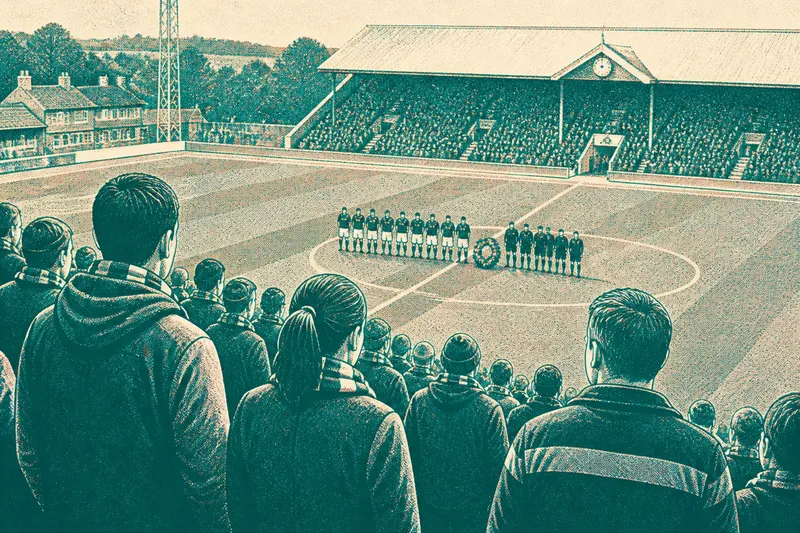
Imagine a fictional club whose starting point is a brief silence before a home fixture after a loss in its community. In a later season, the club makes the pause a regular moment of remembrance. Supporters then suggest including different names and causes. The observable result is a recognisable ritual with a changing focus, rather than a ceremony preserved exactly as it began.
Revision can be mistaken for a break with the past. Yet adapting a custom may preserve its purpose as circumstances change. Describe alterations plainly instead of smoothing them away to make the ritual appear untouched.
Who tells the story?
Clubs, governing bodies, broadcasters, supporters and local communities may tell the same ceremony’s story differently. An official account might emphasise when an organisation adopted it; a supporter might remember an informal practice that came first. Neither perspective settles the question automatically, but their differences can reveal how ownership is shared.
Notice who gets named as the maker of a tradition. An account crediting one official or celebrated figure may leave out the people who repeated a gesture until it caught on. Conversely, an informal crowd custom may later depend on organisers for a place in the event. A fair history can acknowledge both the initial action and the work of keeping it alive.
When gathering memories, ask open questions: What do you remember happening? Where were you? Did people already call it a tradition? Keep recollection distinct from a dated record, and avoid turning disagreement into a contest over who remembers correctly. Memory can show what an event meant even when it cannot establish exactly when it began.
Old words and new customs
Words such as “always”, “annual” and “traditional” can quietly enlarge a custom’s past. “Annual” may mean an event has recurred, not that it has done so for a long time. “Always” often means “for as long as I can remember”. These phrases show how people understand a ritual, but need context before they can serve as a timeline.
Some practices described as one tradition are really several local versions. One club may begin a song, another may adopt it with different words, and a competition may later present both as part of shared heritage. Acknowledge local differences rather than assuming there is one original form.
A custom and the label attached to it are not the same thing. People may perform an action for years without giving it a special name. Once a programme or commentator names it, the action can seem more formal and older than before. The label is part of the custom’s development, not proof of its age.
Writing a fair account
Start with what a reader could observe: who takes part, when it happens, what they do and how the event is arranged. Then give the earliest evidence you have, naming its source and limits. If the custom changed, describe a few clear differences rather than calling it either unchanged or entirely new.
Choose language that matches what you know. “The club introduced the ceremony” suits a claim supported by an announcement or record. “Supporters recall singing the song before the club formalised it” distinguishes memory from documented action. “Its precise beginnings are unclear” is honest when the sources do not settle the matter.
Age is not a test of meaning. A recent ritual can hold grief, pride or welcome; an old one can be debated or altered. To understand whether a sporting tradition is ancient, trace when it appears, how people have changed it and why they continue to take part.
Keep a dated record alongside the living account: a programme, notice, photograph or supporter recollection with its context. That small habit gives the next person a clearer way to distinguish what was remembered, what was revised and what later came to feel timeless.